Clinic in Uganda
A pilot acupuncture clinic in Uganda April 2026 –
a personal perspective
Some journeys begin with a flight. Others begin with a welcome that stays with you forever. Ours began at Mother of Mercy Hospital, in Uganda, where the Banabiikira Sisters (a Catholic nursing order) greeted us with songs of friendship, joy and clapping! Their warmth and generosity set the tone for the fortnight ahead and remains one of the team's most treasured memories.
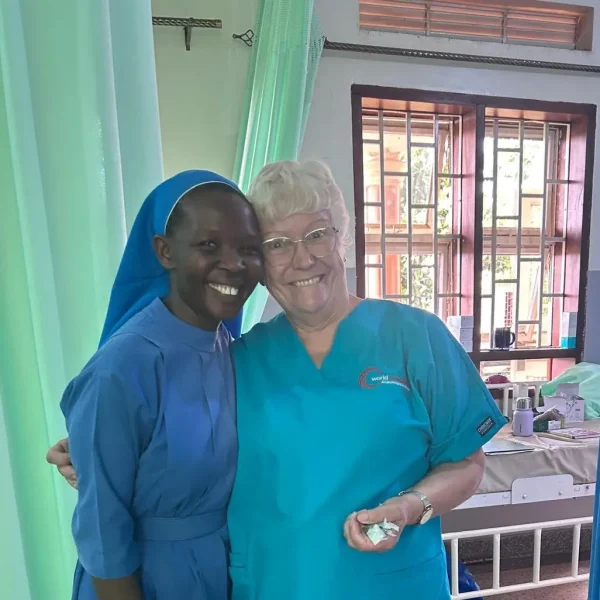
The hospital is situated in Kyengera, a deprived suburb on the outskirts of Kampala. Originally established by the Sisters to provide maternity, mother and child health services in an area of appalling neonatal and infant mortality, the hospital is now expanding its role to offer a range of healthcare services to the wider community.
We travelled to Uganda at the invitation of Sister Gorretti, the hospital administrator, to deliver a pilot multi-bed clinic and introduce acupuncture to the Kyengera community. The concept was new for all the Sisters who nevertheless provided a wonderful room, beds and translators without really knowing what to expect and we thank them for everything but especially for their trust in us to deliver what we promised.
With its rapidly growing population, many families in the Kyengera community work tirelessly to earn a living in the face of limited resources. For them, the hospital is an increasingly important source of accessible healthcare in an area with either no or very limited access to such care. Our free acupuncture camp was an effort to remove the 'poverty penalty' for the poorest residents who cannot afford drug management by offering free rapid pain relief for those whose debilitating chronic conditions translate directly to income loss. For many patients, treatment options are limited. Long-term medication may be unaffordable, unavailable or insufficient to control chronic pain. As a result, many continue to live with conditions that reduce their quality of life and their capacity to support themselves and their families.
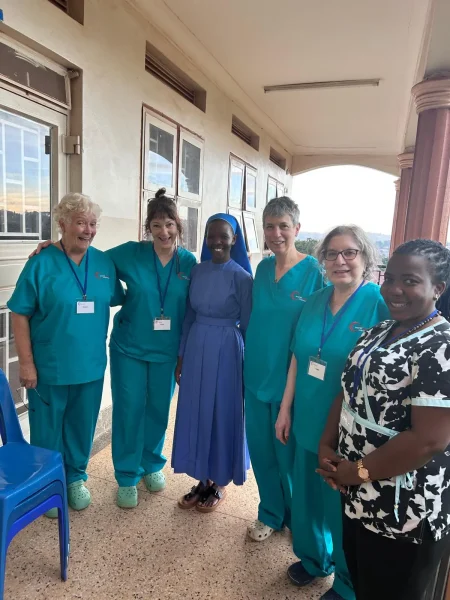
Our team consisted of Teresa, Emma and myself as acupuncturists, with our indefatigable Najma, who handles the registration process, paperwork, ongoing reporting and the calming of queuing patients. Uganda was new for Emma and I, while Teresa was our link and catalyst for being here having volunteered in the country many times with Rotary Doctors wearing her other hat as a radiographer. For Najma it was a coming home – she had been a refugee from Uganda 50 years ago from the Idi Amin era and spent a brief but exciting afternoon recognising landmarks, places she used to visit with her family and exclaiming how it had all changed!
In addition, three local staff joined our team primarily as translators: Rosemary, a qualified SRN with excellent English who was encouraged by the Sisters to join us; Ernest, a newly qualified SEN with equally good English, who had been volunteering at the hospital every day for the last four months while awaiting for his qualifications to be ratified by the Ministry of Health; and Sister Harriet, the hospital pharmacist.
We were used to working through translators from our years of clinics in India, but because we have been told English was widely spoken in Uganda, we had a small hope that they might not be needed here. Not so! The local language is Lagundan, and while some spoke English the patients themselves had great difficulty understanding our accents, although Najma’s slight Indian lilt was much clearer for them.
The clinic was due to start at 8.30 am on Monday morning – so we spent a day pushing beds around, allocating treatment areas and thinking through how our process would work in practice, in that space. Then a day of rest and wondering what we had let ourselves in for, and would anyone turn up?
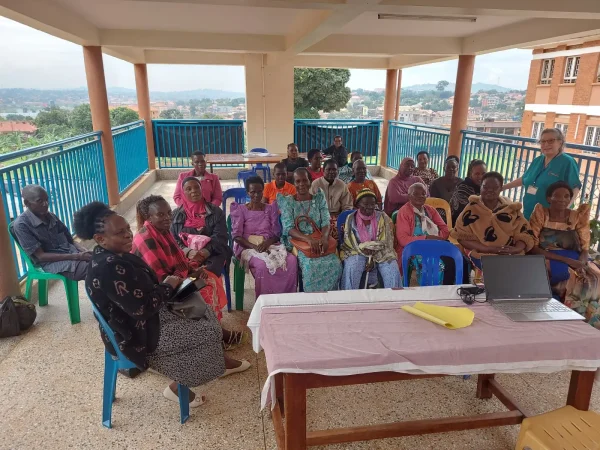
Wandering out of my room at 6.30am on the morning of the clinic, looking for a cup of tea, I was shocked to see a stream of patients arriving through the gates and winding their way up to our reception area where they settled themselves in and prepared to wait.
What followed was two weeks of hard work, a sizeable learning curve, and the building of lasting friendships. And deliver we did! Over 2 weeks we treated 213 patients, giving 706 full body treatments in those 10 days. The majority of patients suffered from pain and musculo- skeletal problems on a burden of generally poor health: hypertension, diabetes, TB, HIV, genetically acquired anaemias, low immunity generally, bowel problems and histories telling of a range of mosquito borne diseases.
One such patient was Michael, a small elderly man leaning heavily on a stick, with an emaciated body set in a permanent curve. He had been a porter all his life, carrying boxes of vegetables for local market traders. He now lived with his son and family. When asked what he would like help with, he said “anything and everything, but something would be good”. It transpired that, despite his back pain, he was more concerned about the number of ‘short calls’ at night, which was also waking up the whole family. The nocturia had increased, recent incontinence was distressing both to him and his daughter in law, and he had had a fall in his efforts to move quickly.
Ren 6, Ren 4, Ren 3 and St 29 with lots of moxa, then yin style tuina to his back was the core treatment and well received. After several treatments he was having fewer short calls, the incontinence and urgency had diminished and the whole family were sleeping better. He brought in 5 eggs from his hens for us to celebrate.
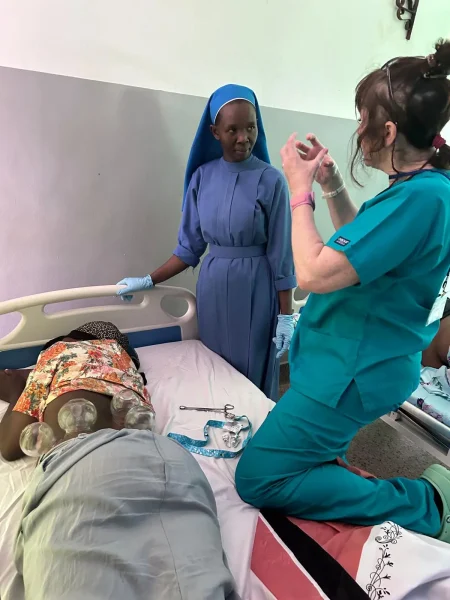
One fragile 75yr old lady was looking after 3 grandchildren and 1 adult son with disability. She would have liked removal of a tooth and a cataract, however settled for treatment of an ulcer and acid reflux of 2 years duration. She was taking herbs from a local healer which gave temporary relief, but came looking for something more permanent. Initially treatment on St and Kid points plus Shenmen and seeds gave a slight improvement, and by a third to consolidate and tonify, she was showing a really good response: +3, which in our scoring system equates to 75% improvement.
The longevity of improvement is an issue for pop up clinics such as ours. Just as this lady has temporary relief with herbs – will the improvement she had with needles be sustained after we pack up and leave? We believe it does. We ask for verbal feedback at the time of discharge and always offer advice on exercise and nutrition during clinics, but we also carry out reviews at a three month point when a World Medicine team ring a random 20% of patients to see how they have been since they were treated. The result is usually an overwhelming positive, coupled with a query about when our next visit will be. Our India experience bears this out over the years we have been there. On our last visit to Chaparda I met with a gentleman I have treated several years running. He said “I am glad to see you. Three years ago, I had back pain and sciatica, and it went. Last year you treated me for migraines, now gone. I have been told I need surgery – but I have told them I shall wait until after the acupuncture camp before I decide if it’s necessary”.
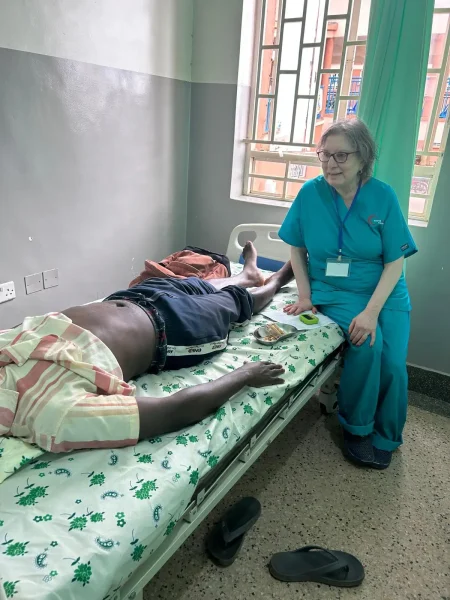
Other lovely patients come to mind, and small successes with conditions that had loomed large in their lives
- the 11yr old schoolboy with nosebleeds that had happened every other day for about 5 weeks. Du23 and LI20 were used amongst others, and at the last treatment just before we wound the clinic up, he reported no bleeds for 9 days. A happy result not just for our lad, but it also eased the constant look of worry from Mum’s face.
The hundreds of backs and shoulders treated, and
the lady who had come in with pain in both knees, now rabbit hopping around the clinic to show how much better they were!
the older gent who had originally been brought in by his son on the back of his boda-boda (motorcycle taxi) and helped into reception, now strolling in by himself.
As the days progressed, the atmosphere of the clinic changed. The nervousness of the waiting patients the first couple of days had been palpable. The trust in the nuns bringing us to the hospital may have been their backstop, but for a patient who has volunteered for an unknown therapy this is not neutral ground. However, still they came and what a wonderful sight they were. Frequently dressed in the bright colours of batik dyed cottons, many of the older ladies in their traditional Gomesi costumes. Some waited for hours, some agreed to come back the following day once we had checked our capacity, but all showed patience and tolerance, sharing water and kindness to the older patients and children waiting, some even allowing them to ‘jump the queue’ if asked.
The atmosphere within the clinic changed too. The whole team started out a little nervous, as is the way with pilots. Sister Harriet, as the pharmacist, was a senior member of the hospital staff and held herself slightly in reserve, to the point I did wonder if she was there to keep an eye on us, as well as translate! However, returning patients reporting improvements in their conditions clearly spiked her curiosity and by the end of the first week she was happily cupping backs, applying moxa and massaging. The following week she topped this by breaking into song as she moved around the clinic!
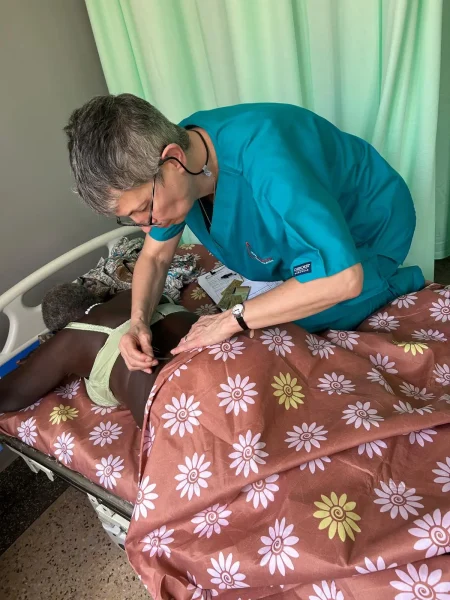
So the quiet reserve of the initial days had now been replaced by the wonderful sound of a busy clinic in progress. The low hum of chatter from waiting patients, exchanging stories and catching up with gossip. Windows open to let in air, the sound of distant car horns, an occasional roar of a passing boda-boda and the sudden thrum of an afternoon downpour.
Almost as soon as we started, we were done. If someone had asked us before we left what a pilot multi-bed clinic in Uganda would look like, we might have spoken about hard work, long hours and the unknown. Returning home, however, we found ourselves talking about something quite different: the warmth of our welcome, the enthusiasm of our Ugandan colleagues, the remarkable sense of purpose that made every challenge worthwhile and, most of all, the privilege of caring for patients whose dignity and kindness we will never forget.
And if anyone is wondering – yes, we will be back!
Barbara Robinson
Trustee, World Medicine Charitable Trust